What Actually Happens Inside Your RO Purifier? (Stage-by-Stage Breakdown)
Ever wondered what actually goes on inside your RO water purifier? We break down every filtration stage — from sediment to post-carbon — so you know exactly what's cleaning your family's drinking water.
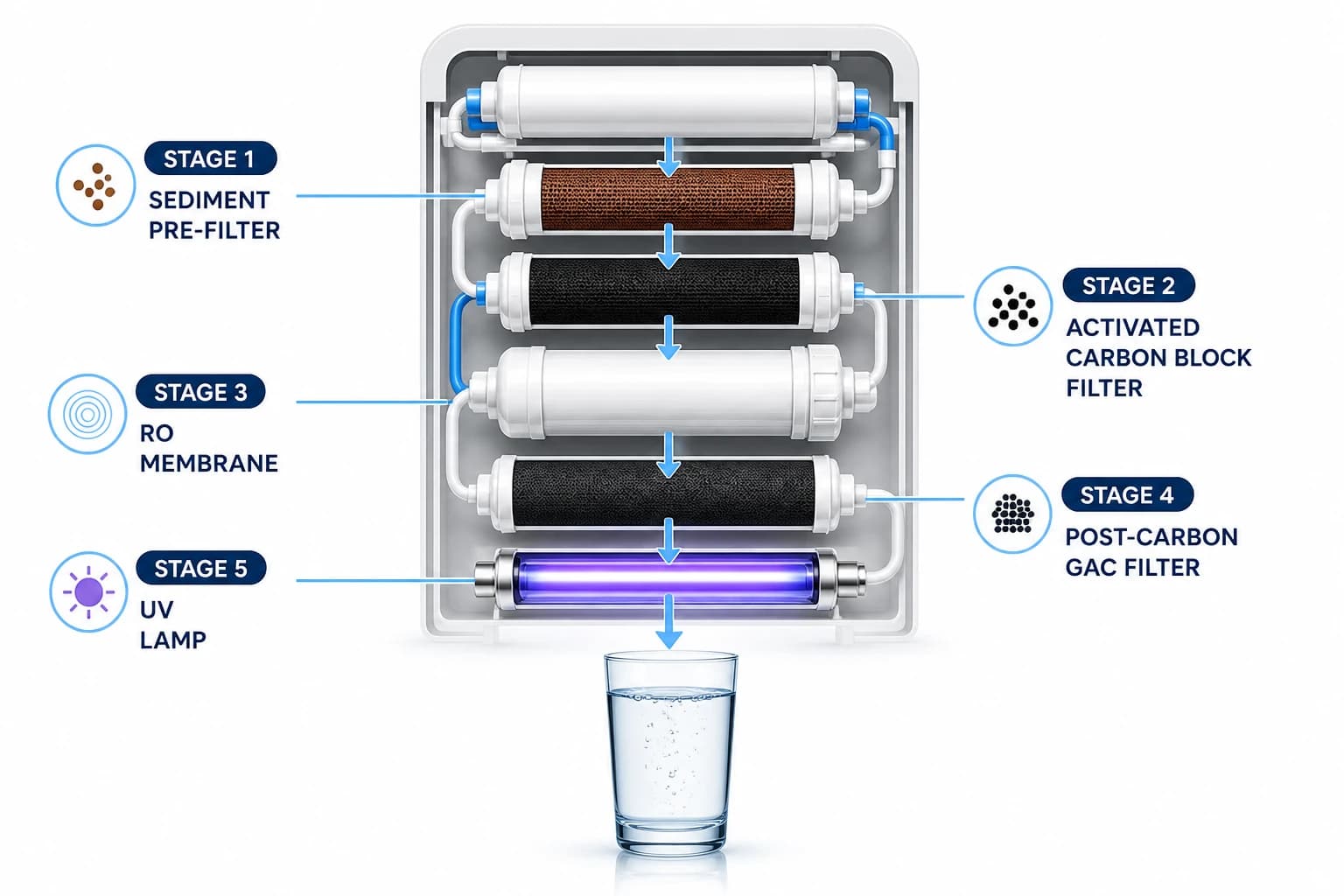
Most of us pour a glass of water from our RO purifier every single day without a second thought. Which is exactly how it should be. But here is a question worth asking: do you actually know what is happening inside that plastic box under your sink?
Understanding how your RO purifier works is not just satisfying — it helps you recognise when something is wrong, why your water might taste different, and when it is time to call a technician. So let us open up the machine, stage by stage, and walk through exactly what is happening to your water.
How Does an RO Purifier Actually Work?
Before we get into the individual stages, it helps to understand the big picture.
Reverse osmosis works by forcing water through a semi-permeable membrane under pressure. This membrane has pores so tiny — roughly 0.0001 microns — that water molecules can squeeze through, but dissolved salts, heavy metals, bacteria, and most chemical contaminants cannot. The clean water that passes through is called the permeate or product water. The contaminated water that gets rejected is called the concentrate or reject water, which flows down your drain.
But here is the thing: if you pushed raw tap water straight through an RO membrane, the membrane would clog within days. That is why every RO system has a series of pre-filters that prepare the water before it reaches the membrane, and post-filters that polish it after. Each stage has a specific, essential job.
Stage 1: The Sediment Pre-Filter — The Bouncer at the Door
The first thing your water meets when it enters the purifier is the sediment pre-filter, usually rated at 5 microns. Its job is straightforward: catch anything visible or near-visible in the water.
This includes:
- Sand and grit from old pipes
- Rust flakes from corroded infrastructure
- Suspended clay and silt particles
- Fine sediment from municipal supply
In cities like Amritsar, where municipal pipelines are aging and water can travel long distances before reaching your home, sediment levels can be surprisingly high — especially after monsoons or when supply pressure fluctuates.
When the sediment filter turns dark brown or grey, it is doing its job. When it gets too blocked, it restricts water flow and forces every downstream stage to work under strain. This is why replacing your sediment filter every 3 to 6 months is non-negotiable maintenance — it directly protects every other component in the system.
Stage 2: The Activated Carbon Block Filter — The Chemical Neutraliser
Once the sediment is removed, your water moves into the activated carbon block filter. This is one of the most important pre-treatment stages, and the reason your purified water does not smell like a swimming pool.
Activated carbon is an incredibly porous material — one gram of it has a surface area roughly the size of four tennis courts. It works through a process called adsorption, where chemical molecules stick to the carbon's surface as water flows past.
The carbon stage removes:
- Chlorine and chloramines — added by municipal treatment plants to kill bacteria, but harmful to RO membranes over time
- Chlorine by-products like trihalomethanes — linked to long-term health concerns
- Pesticides and herbicides from agricultural runoff, particularly relevant for Punjab's water supply
- Volatile organic compounds from industrial sources
- Bad tastes and odours — the earthy, musty, or chemical smell common in treated tap water
Chlorine physically degrades polyamide RO membranes over time. The carbon pre-filter acts as a chemical shield, absorbing the chlorine before it ever reaches the membrane. Carbon filters need replacement every 6 months.
Stage 3: The RO Membrane — The Heart of the System
This is where the real magic happens. The RO membrane is the most sophisticated and expensive component in your purifier, and it does something no other filter stage can: it removes dissolved contaminants at the molecular level.
The membrane is a thin-film composite material, wound tightly in a spiral around a central collection tube. As water is forced against it under pump pressure — typically 50 to 80 PSI — water molecules pass through while dissolved impurities are flushed out through the drain line.
| Contaminant | Removal Rate |
|---|---|
| Dissolved salts (TDS) | 85 – 99% |
| Lead and arsenic | Up to 99% |
| Nitrates and fluorides | 85 – 95% |
| Bacteria and viruses | 99.9%+ |
| Heavy metals (mercury, chromium) | 96 – 99% |
A standard 75 GPD membrane found in most residential Amritsar systems can produce roughly 280 litres of purified water daily. It should last 2 to 3 years under normal conditions, though high-TDS source water will shorten its lifespan.
Concerned your membrane might be failing? Our team checks TDS before and after every RO membrane replacement service to confirm the new membrane is performing correctly.
Stage 4: The Post-Carbon Filter — The Final Polish
After the membrane, your water is chemically clean but can sometimes taste slightly flat due to the near-total removal of dissolved minerals. The post-carbon filter (GAC cartridge) addresses this.
Its two main jobs:
- Remove any residual tastes or odours picked up from the storage tank
- Add a polished, clean taste before the water reaches your tap
This is a light-duty stage — the membrane has already done the heavy lifting — but it makes a noticeable difference in taste quality. Replace it once a year.
Stage 5: The UV Lamp — The Biological Kill Switch
Many modern RO systems — particularly those designed for Indian municipal water — include a UV (ultraviolet) stage either before or after the membrane. The UV lamp emits radiation at 254 nanometres, a wavelength that is lethal to microorganisms.
When bacteria, viruses, or cysts pass through the UV chamber, the radiation damages their DNA, rendering them unable to reproduce. They remain in the water as inactivated cells but are completely harmless.
Why include UV if the RO membrane already blocks bacteria?
- Redundancy — if the membrane ever develops a tiny crack, UV provides a backup biological barrier
- Membrane protection — UV placed before the membrane prevents biofouling on its surface
UV lamps must be replaced every 12 months, as effectiveness drops significantly after that point even if the lamp is still glowing.
What Happens to the Reject Water?
For every litre of purified water produced, an RO system discharges roughly 2 to 3 litres of concentrate water down the drain. This carries all the dissolved salts and heavy metals the membrane rejected.
The reject water can be reused for mopping, watering plants, or flushing toilets. If you notice your drain line running constantly even when the storage tank is full, that is a warning sign that your membrane may be damaged. Our RO repair service can diagnose this within a single visit.
The Complete Water Journey
| Step | Stage | What It Removes | Replace Every |
|---|---|---|---|
| 1 | 🟫 Sediment Pre-Filter | Sand, rust, silt, clay | 3 – 6 months |
| 2 | ⚫ Carbon Block Filter | Chlorine, pesticides, odours, VOCs | 6 months |
| 3 | 💧 RO Membrane | Dissolved TDS, heavy metals, bacteria, viruses | 2 – 3 years |
| 4 | 🔵 Post-Carbon / GAC | Residual taste and odour from storage tank | 12 months |
| 5 | 🟣 UV Lamp (if present) | Remaining microorganisms | 12 months |
| ✅ | Your Tap | Pure, safe drinking water | — |
Each stage depends on the one before it. When one filter goes past its replacement date, the entire chain is compromised.
Why Regular Servicing Matters
Now that you can visualise what is happening inside your purifier, the importance of regular maintenance becomes much clearer. It is not about keeping a machine running — it is about making sure every single one of these stages is working as designed.
A sediment filter three months overdue is allowing particles to reach and abrade your membrane. A carbon filter not changed on time is letting chlorine degrade the membrane surface. A membrane two years old without a TDS check may be passing heavy metals directly into your glass.
This is exactly what our Annual Maintenance Contract is designed to prevent — regular, scheduled inspections that catch deterioration before it becomes a health issue.
Ready to Make Sure All Your Stages Are Working?
- Book a complete RO service in Amritsar — our technicians inspect all stages and provide TDS verification
- Explore our Annual Maintenance Contract — scheduled servicing so you never miss a filter change
- Shop genuine replacement filters and membranes — OEM-compatible parts at transparent prices
References
- World Health Organization — Guidelines for Drinking-water Quality, 4th Edition
- U.S. Environmental Protection Agency — Point-of-Use Reverse Osmosis Systems
- Bureau of Indian Standards — IS 10500:2012 Drinking Water Specification
- Water Quality Association — Consumer Resources on Reverse Osmosis
- NSF International — Drinking Water Treatment Unit Standards
Frequently Asked Questions
Article Insights & FAQs
Related Topics
More Insights
View All Stories
Need Expert Help?
Our certified technicians are ready to service your RO system and ensure pure water for your family.