How Much Water Does Your RO Purifier Waste? (And 7 Smart Ways to Reuse It)
A standard RO purifier wastes 2–3 litres of water for every litre it purifies. With Punjab's groundwater already at a crisis level, here is exactly how much your system is wasting — and 7 practical ways to reuse every drop.
TL;DR:
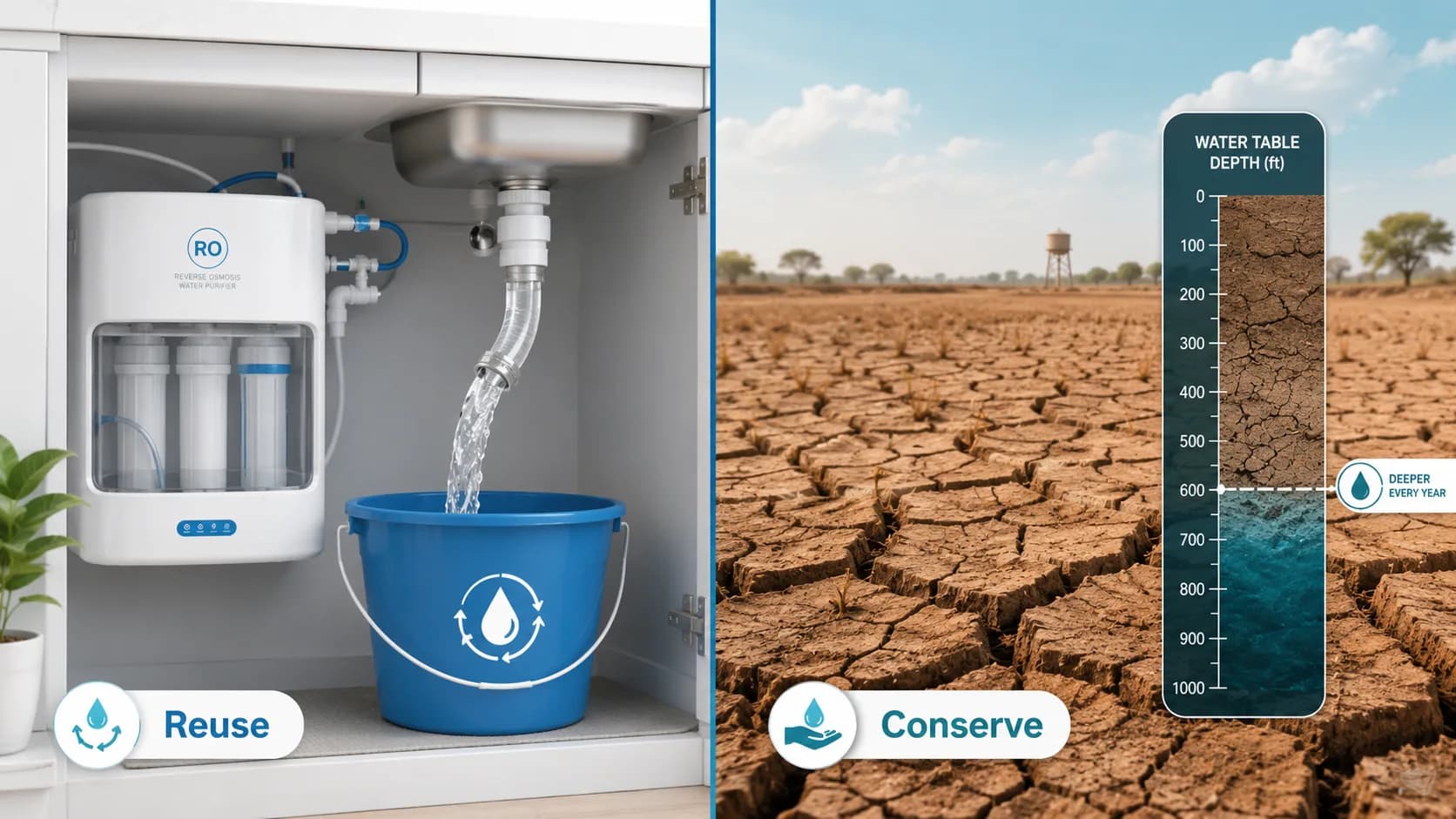
A conventional RO purifier has a recovery rate of just 25–30%, meaning it produces 2.5 to 3 litres of reject water for every litre of clean drinking water. The government's NGT and new MoEF&CC rules now require a minimum 60% recovery rate for RO systems. You cannot eliminate this waste, but you can reuse it — for mopping, toilet flushing, gardening, and more — recovering nearly all of it for productive household use.
What Is RO Reject Water?
RO reject water — also called wastewater, drain water, or concentrate — is the water your RO purifier flushes down the drain during filtration. It is not "dirty" water in the traditional sense. It is simply tap water with a higher-than-normal concentration of the dissolved salts, heavy metals, and minerals that the RO membrane rejected. It is not safe to drink, but it is perfectly usable for dozens of household tasks.
Understanding where this water goes and how much of it is produced is the first step toward not wasting it.
How Much Water Is Your RO Actually Wasting?
Most homeowners have no idea. The answer depends on your system's recovery rate — the percentage of input water that becomes purified drinking water.
| RO System Type | Recovery Rate | Pure Water Produced | Water Wasted |
|---|---|---|---|
| Standard conventional RO | 25 – 30% | 1 litre | 2.5 – 3 litres |
| Mid-range efficiency RO | 40 – 50% | 1 litre | 1 – 1.5 litres |
| High-efficiency / Eco RO | 60%+ | 1 litre | Less than 1 litre |
| NGT mandated minimum (2023) | 60% | 1 litre | 1 litre or less |
If your family drinks 10 litres of purified water a day from a standard RO system, your purifier is sending 25 to 30 litres of water down the drain every single day — approximately 900 litres per month.
To put that in context: Punjab's groundwater extraction rate stands at 156% of its recharge capacity, making it the most over-exploited state in India. Of Punjab's 153 assessed groundwater blocks, 111 — over 72% — are classified as over-exploited. Every litre saved at home matters more here than almost anywhere else in the country.
Why Does RO Waste So Much Water?
This is not a design flaw — it is a physical reality of how reverse osmosis works.
The RO membrane filters by forcing water through microscopic pores under pressure. As pure water molecules pass through, dissolved contaminants concentrate on the membrane's surface. If this concentrated layer is not continuously flushed away, it would foul and damage the membrane within days. The reject stream serves as a continuous cleaning mechanism for the membrane itself.
What affects how much water is wasted:
- Input water TDS — Higher TDS means a larger concentration of dissolved solids to reject, increasing waste ratios
- Water pressure — Low incoming pressure (below 40 PSI) forces the system to waste more water per litre produced
- Filter condition — Clogged pre-filters reduce system efficiency significantly, increasing reject ratios
- Membrane age — An aging membrane that has lost its rejection efficiency wastes more water while filtering less effectively
A poorly maintained RO with old pre-filters and low input pressure can waste 4–5 litres per litre of purified water — far above the already high industry average. This is one of the strongest arguments for keeping your system serviced. Our Annual Maintenance Contract includes pressure checks and filter condition assessments at every visit to keep your system running at peak efficiency.
What the Indian Government Now Requires
In 2023, the Ministry of Environment, Forest and Climate Change (MoEF&CC) published the Water Purification System (Regulation of Use) Rules, 2023 — the first specific regulatory framework for domestic RO systems in India.
Key requirements:
- RO systems must achieve a minimum 60% water recovery rate
- Reject water must be managed and reused — not simply drained
- BIS standard IS 16240:2023 now specifies technical efficiency requirements for point-of-use RO systems
If you own an older conventional RO system, it almost certainly does not meet these standards. This does not mean you need to replace it immediately — but it does mean reusing your reject water is no longer just a good habit. It is increasingly the expected practice.
7 Smart Ways to Reuse Your RO Reject Water
The good news: reject water is not contaminated in ways that make it unusable. It is simply water with a higher TDS. Here is how to put it to work.
1. Mopping and Floor Cleaning
The most immediate and obvious use. Collect reject water in a bucket directly under the drain pipe. Use it for your daily mopping — it cleans floors just as effectively as tap water.
2. Toilet Flushing
Route the reject water drain pipe into your toilet's flush tank or collect it and pour manually. A single flush uses 6–10 litres of water. Using reject water for all flushes can save thousands of litres per month.
3. Pre-washing Utensils and Dishes
Use reject water for the initial rinse of dishes to remove food particles before the soap wash. This is completely safe — you are not consuming it.
4. Gardening and Outdoor Plants
Check your reject water TDS with a pocket meter first. If it reads below 800–1000 ppm, it is generally safe for hardy outdoor plants and garden beds. Avoid using very high-TDS reject water on delicate house plants or edible crops. Water in the morning or evening to reduce evaporation.
5. Car and Vehicle Washing
Use reject water for the main wash. Do a quick final rinse with fresh water to prevent salt deposits from forming on the bodywork.
6. Pre-soaking Laundry
Use it for soaking heavily soiled clothes before the main machine wash. It loosens dirt just as effectively as regular tap water.
7. Outdoor Cleaning — Driveways, Patios, and Corridors
Sweep and mop outdoor areas using collected reject water. With a simple diverter pipe attached to your drain outlet and a storage bucket or drum, you can passively collect reject water without any ongoing effort.
How to Set Up Reject Water Collection (No Plumber Needed)
Most RO systems have a flexible drain pipe that runs to your kitchen sink drain. You can redirect this in under 10 minutes:
- Disconnect the drain pipe from the sink drain fitting
- Place the free end into a large bucket or drum (10–20 litre capacity works well)
- The bucket fills during RO operation — empty it into toilet, mop bucket, or garden as needed
- Alternatively, ask your technician to plumb the drain pipe directly to your toilet flush tank on your next service visit
Our RO service team can set up a permanent reject water diversion line during any scheduled service visit — no separate appointment needed.
What If You Want to Actually Reduce the Waste, Not Just Reuse It?
Reusing reject water is the most practical solution for most households. But if you want to physically reduce the volume wasted, here are the technical options:
| Solution | Effect | Cost |
|---|---|---|
| Booster pump installation | Raises input pressure to 60–80 PSI, improving recovery rate | ₹1,500 – ₹3,000 |
| Permeate pump | Uses reject water energy to push more pure water through | ₹2,000 – ₹4,000 |
| Regular pre-filter replacement | Prevents clogging-related efficiency drop | ₹300 – ₹800 per service |
| Upgrade to high-efficiency RO | 60%+ recovery rate built in | ₹12,000 – ₹25,000 |
For most Amritsar households, a combination of regular filter maintenance and reject water reuse is the most cost-effective approach. A booster pump is worth considering if your building's water pressure is consistently low.
The Punjab Water Context: Why This Matters More Here
Punjab's water crisis is well-documented and accelerating. The CGWB's latest assessment records groundwater extraction at 156% of the annual recharge rate. In practical terms: for every litre of groundwater replenished by rain and natural recharge, Punjab extracts 1.56 litres. The deficit compounds every year.
The Jal Shakti Ministry has flagged this through its Jal Shakti Abhiyan campaign, and the NGT has specifically called out domestic RO wastage as a contributing factor to urban water depletion.
In this context, reusing your RO reject water is not just an eco-friendly gesture — it is a meaningful contribution to a state that is genuinely running out of groundwater.
What to Do Next
- 🪣 Set up reject water collection today — redirect your drain pipe into a bucket, takes 5 minutes
- 🔧 Book a service visit — our technicians check system pressure and filter condition, and can install a permanent diversion line
- 📋 Annual Maintenance Contract — includes efficiency checks at every visit
- 🛒 Shop replacement pre-filters and membranes — keeping filters fresh is the single biggest thing you can do to reduce waste ratios
- 📞 Talk to our team about booster pump installation — recommended if your building pressure is consistently low
References
- Central Ground Water Board, Government of India — Official Portal & Groundwater Assessment Data — Source for Punjab's 156% extraction rate and block-wise over-exploitation data.
- Ministry of Jal Shakti, Government of India — Jal Shakti Abhiyan Portal — National water conservation initiative data and groundwater resource statistics.
- Ministry of Environment, Forest and Climate Change — Water Purification System (Regulation of Use) Rules 2023 — Official gazette notification of 60% recovery rate mandate for RO systems.
- Bureau of Indian Standards — IS 16240:2023 — Reverse Osmosis Point-of-Use Water Treatment Systems — Technical standard specifying efficiency and performance requirements for domestic RO purifiers.
- Sankalp Taru Foundation — India's RO Water Wastage Problem — NGO-published data on domestic RO wastage volumes and environmental impact in urban India.
Frequently Asked Questions
Article Insights & FAQs
More Insights
View All Stories
Need Expert Help?
Our certified technicians are ready to service your RO system and ensure pure water for your family.