RO vs UV vs UF Water Purifiers: Which One Is Actually Right for Your Home?
RO, UV, or UF — which water purifier should you actually buy? We break down how each technology works, what it removes, and which one is right for your home based on your water source and TDS level.
TL;DR:
If your water TDS is above 300 ppm — which it likely is in Amritsar and most of Punjab — you need an
RO purifier
. UV kills bacteria but does nothing about dissolved salts, heavy metals, or chemicals. UF works without electricity but cannot handle high TDS either. For Indian water conditions, RO (or RO+UV combined) is the only technology that addresses the full range of contaminants. Test your TDS first, then decide.
Walk into any electronics store in India and you will be hit with the same question from the salesperson: "Sir, RO lena hai ya UV?" Most of us nod along without really knowing the difference. And that is a problem — because choosing the wrong purifier means either paying for filtration you do not need, or worse, drinking water that is not actually safe.
This guide cuts through the marketing noise and tells you exactly what each technology does, what it cannot do, and which one matches your specific water situation.
The Quick Answer — Side by Side
| Feature | RO | UV | UF |
|---|---|---|---|
| Removes dissolved salts (TDS) | ✅ Yes | ❌ No | ❌ No |
| Removes heavy metals (lead, arsenic) | ✅ Yes | ❌ No | ❌ No |
| Kills bacteria and viruses | ✅ Yes | ✅ Yes | ✅ Partially |
| Removes pesticides and chemicals | ✅ Yes | ❌ No | ❌ No |
| Works without electricity | ❌ No | ❌ No | ✅ Yes |
| Wastes water during filtration | ⚠️ Yes (2–3x) | ❌ No | ❌ No |
| Best for high TDS / hard water | ✅ Yes | ❌ No | ❌ No |
| Best for low TDS municipal water | ⚠️ Overkill | ✅ Yes | ✅ Yes |
| Maintenance cost | Medium | Low | Low |
Now let us understand why each column looks the way it does.
How Each Technology Actually Works
Reverse Osmosis (RO)
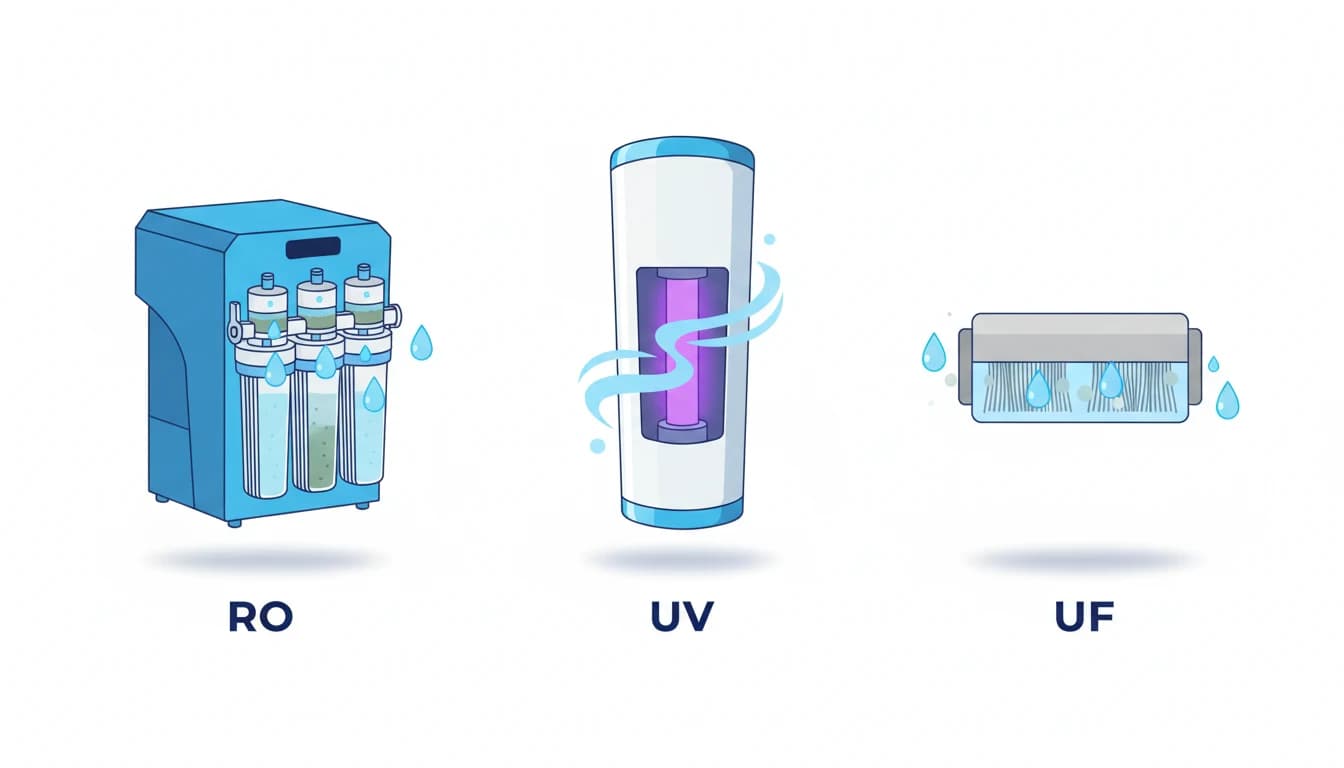
RO pushes water through a semi-permeable membrane under pressure. The membrane's pores are roughly 0.0001 microns — small enough to block dissolved salts, heavy metals, bacteria, viruses, pesticides, and pharmaceutical residues. What comes out on the other side is water stripped down to near-pure H₂O.
This is the only technology on this list that reduces TDS (Total Dissolved Solids) — the measure of dissolved minerals, salts, and metals in your water. Everything else on the market leaves TDS completely unchanged.
UV (Ultraviolet Purification)
UV purifiers pass water past a ultraviolet lamp emitting light at 254 nanometres. This wavelength penetrates the cell walls of bacteria, viruses, and other microorganisms and destroys their DNA, making them unable to reproduce. The organisms remain in the water as harmless, inactivated cells.
Here is the important thing most people miss: UV does not remove anything from the water. It only neutralises living organisms. If your water has dissolved lead, nitrates, or pesticides, UV does absolutely nothing about it. The water after UV treatment has the same TDS as before.
UF (Ultrafiltration)
UF uses a hollow-fibre membrane with pores of around 0.01 to 0.1 microns — much larger than an RO membrane but still small enough to physically block bacteria, cysts, and larger particles. Unlike RO, it operates at low pressure and does not need electricity.
However, UF pores are too large to block viruses or dissolved contaminants. It is essentially a very fine mechanical filter — excellent for removing biological threats from relatively clean water, but not designed for high-TDS or chemically contaminated sources.
When Should You Choose RO?
RO is the right choice when your water has:
- TDS above 300 ppm — this is the threshold the Bureau of Indian Standards uses to recommend RO treatment
- High hardness — calcium and magnesium deposits that cause scale buildup, white residue, and affect taste
- Heavy metal contamination — lead, arsenic, iron, or chromium, common in areas with old pipeline infrastructure or industrial activity
- Agricultural chemical runoff — nitrates, pesticides, and herbicides, highly relevant across Punjab
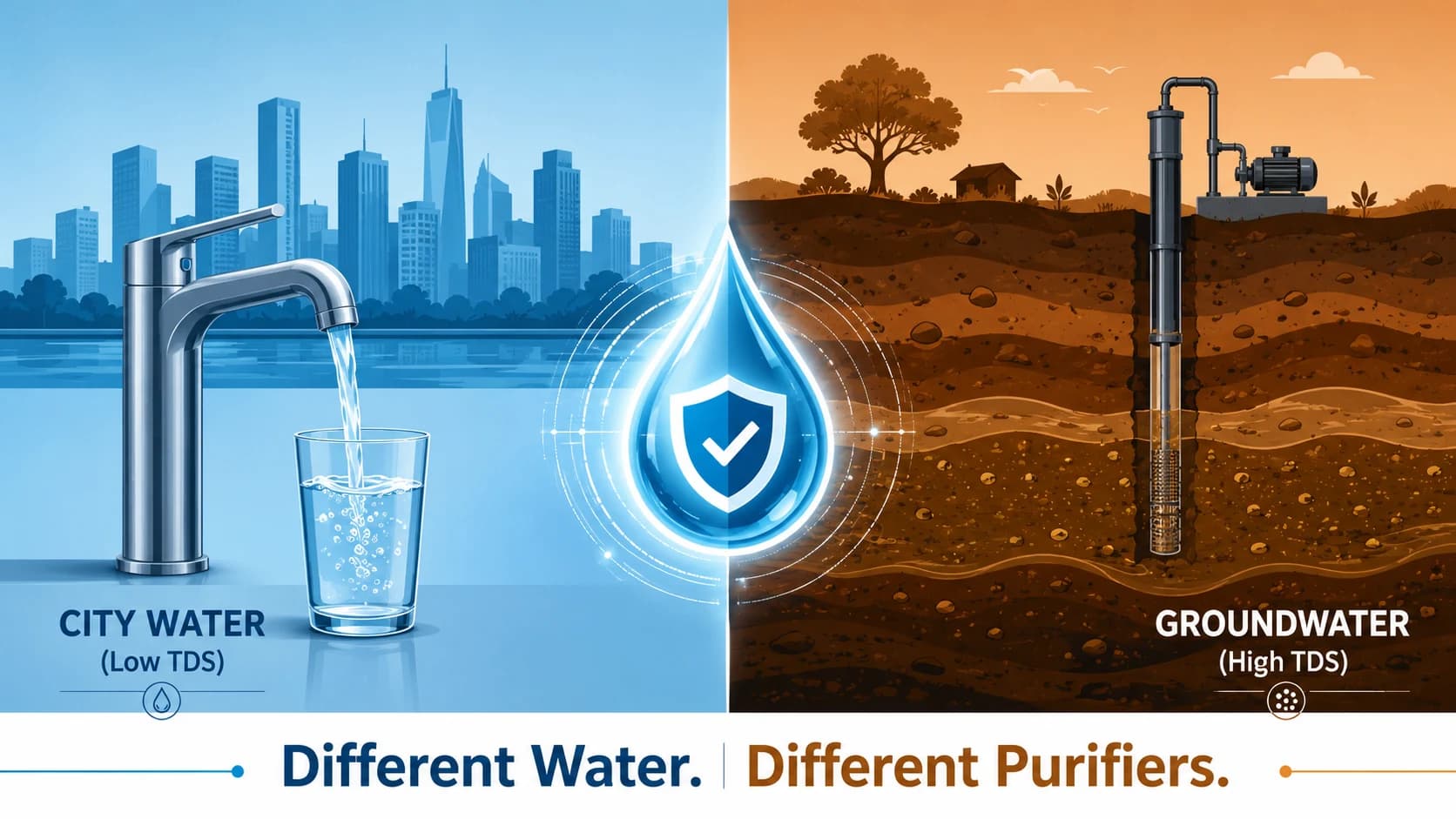
- Groundwater or borewell source — almost always has higher TDS than municipal supply
If your water ticks any of these boxes, neither UV nor UF can help you. Only RO brings TDS down to safe, tasteable levels.
One thing worth knowing: RO does remove beneficial minerals like calcium and magnesium along with the harmful ones. Modern RO systems address this with a TDS controller or mineraliser stage that adds back a controlled amount of essential minerals after filtration. When shopping for an RO, look for this feature.
When Is UV Enough?
UV makes sense when:
- Your TDS is below 200 ppm — water is already mineral-light and does not need dissolved solids removed
- You are on treated municipal supply that is chemically safe but may carry biological contamination
- You want a lower-maintenance, electricity-efficient solution
- You live in an area with no known heavy metal or pesticide issues
The risk with UV-only systems is that they provide zero protection against chemical and dissolved contaminants. In cities like Amritsar where aging pipe infrastructure can introduce lead and rust into otherwise treated municipal water, UV alone creates a false sense of security.
When Does UF Make Sense?
UF is ideal when:
- You need purification without electricity — useful for areas with frequent power cuts or as a backup system
- Your source water TDS is already low and you mainly want to remove biological contamination and sediment
- You want a zero-waste purification system with no reject water
UF is commonly used in rural areas, as a pre-treatment stage before UV, or as a travel/portable solution. For most urban Indian households dealing with municipal supply and TDS levels above 300 ppm, UF alone is not sufficient.
How to Decide: Check Your TDS First
Before buying any purifier, spend ₹150 on a pocket TDS meter from any hardware or Amazon and test your tap water. The number you get tells you exactly what you need:
| Your TDS Reading | What You Need |
|---|---|
| Below 150 ppm | UF or UV is sufficient |
| 150 – 300 ppm | UV recommended; RO optional |
| 300 – 500 ppm | RO strongly recommended |
| Above 500 ppm | RO is essential |
If you are in Amritsar or anywhere in central Punjab, there is a strong chance your groundwater or municipal supply TDS sits between 400 and 800 ppm — the range where RO is not just recommended but necessary for long-term health.
The Amritsar and Punjab Context
Punjab's water quality situation is well-documented. Agricultural runoff from decades of intensive farming has introduced nitrates, pesticides, and heavy metals into groundwater across the state. The National Green Tribunal has flagged multiple districts for unsafe groundwater. Municipal treatment plants handle biological contamination well, but dissolved chemical contaminants pass straight through conventional treatment.
This is the specific reason why UV-only purifiers — despite being cheaper and lower maintenance — are not adequate for the majority of Punjab households. RO is the only technology that addresses the full spectrum of what is actually in the water here.
Our RO installation service in Amritsar includes a free TDS test before and after installation so you can see exactly what your system is removing.
What About RO + UV Combined Systems?
Most quality residential purifiers now combine RO and UV in a single unit. This gives you the best of both technologies:
- RO membrane handles dissolved salts, heavy metals, and chemicals
- UV lamp provides a biological backup — if the membrane ever develops a microscopic crack, UV ensures no bacteria make it to your glass
For Indian water conditions, RO+UV is the gold standard. It is what we install in most homes across Amritsar, and it is what the BIS and WHO guidelines point to for high-TDS source water.
Side-by-Side: The Real Cost Over 3 Years
| RO System | UV System | UF System | |
|---|---|---|---|
| Purchase price | ₹8,000 – ₹20,000 | ₹3,000 – ₹8,000 | ₹2,000 – ₹6,000 |
| Annual maintenance | ₹2,000 – ₹4,000 | ₹800 – ₹1,500 | ₹500 – ₹1,000 |
| 3-year total cost | ₹14,000 – ₹32,000 | ₹5,400 – ₹12,500 | ₹3,500 – ₹9,000 |
| Protects against high TDS | ✅ Yes | ❌ No | ❌ No |
When you factor in the health cost of drinking high-TDS or chemically contaminated water — including kidney stones, heavy metal toxicity, and gastrointestinal issues — the cost gap between RO and the cheaper alternatives becomes much less significant.
The Bottom Line
- High TDS, borewell, or groundwater source → RO is non-negotiable
- Low TDS treated municipal water, no chemical concerns → UV is enough
- No electricity, low-contamination rural source → UF works
- Best all-round protection for Indian conditions → RO + UV combined
If you are unsure about your water quality, the safest and cheapest first step is to grab a TDS meter and test your tap water today. The number will tell you everything you need to know.
- 🔧 Book a free water quality check in Amritsar
- 🛡️ Explore our RO installation service
- 📋 Learn about our Annual Maintenance Contract
References
- Bureau of Indian Standards — IS 10500:2012 Drinking Water Specification
- World Health Organization — Guidelines for Drinking-water Quality, 4th Edition
- U.S. Environmental Protection Agency — Drinking Water Regulations and Contaminants
- NSF International — Certified Drinking Water Treatment Units (RO Systems)
- National Green Tribunal India — Official Portal
Frequently Asked Questions
Article Insights & FAQs
Related Topics
More Insights
View All Stories
Need Expert Help?
Our certified technicians are ready to service your RO system and ensure pure water for your family.