Is RO Water Actually Safe to Drink Every Day? Here's What the Science Says
Millions of Indian families drink RO water daily — but is it actually safe long-term? We look at what the science says about demineralised water, what WHO and BIS recommend, and what you should do about it.
TL;DR:
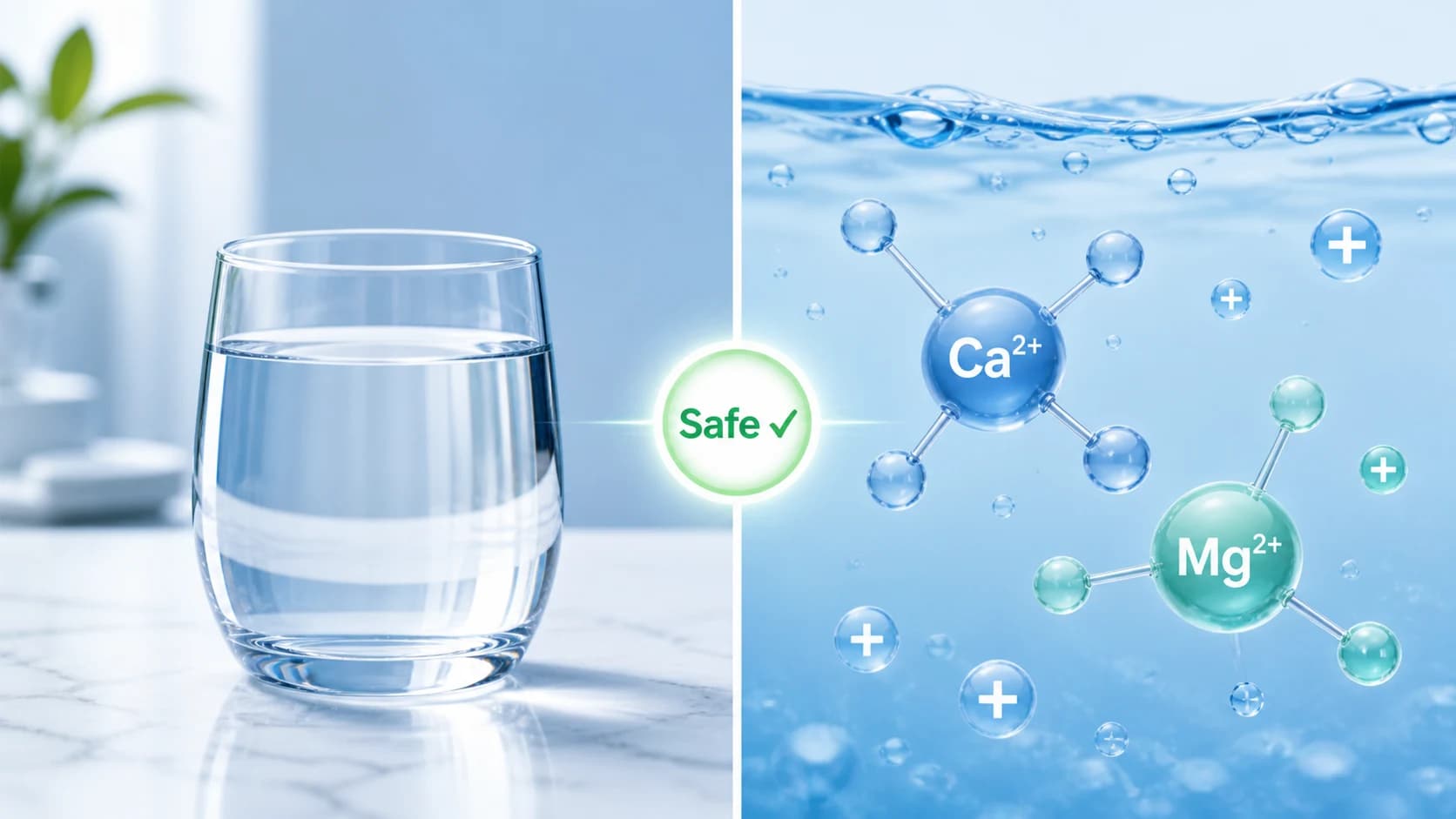
Yes, RO water is safe to drink daily — especially in India where tap water often contains heavy metals, pesticides, and excess dissolved solids. The main concern is that RO removes beneficial minerals like calcium and magnesium along with the harmful ones. The fix is simple: use an RO system with a mineraliser or TDS controller, maintain a balanced diet, and keep your TDS output between 50 and 150 ppm. For households in Punjab and Amritsar where groundwater contamination is documented, the risk of
not
using RO is far greater than the mineral debate.
If you own an RO water purifier, you have probably heard someone say it at a family gathering or on social media: "RO water is bad for you. It removes everything — even the good minerals."
It is a valid question. And like most things in nutrition and health, the honest answer is: it depends.
Let us go through the science, the standards, and what it actually means for your family's daily water consumption.
What Does RO Water Actually Remove?
Reverse osmosis does not distinguish between contaminants and nutrients. The membrane filters by molecular size — anything larger than a water molecule gets blocked, and that includes both harmful dissolved solids and naturally occurring beneficial minerals.
Here is what a standard RO system removes from water:
| What Gets Removed | Harmful or Beneficial? |
|---|---|
| Lead, arsenic, mercury | ❌ Harmful — must be removed |
| Nitrates and fluoride (excess) | ❌ Harmful at high levels |
| Pesticides and herbicides | ❌ Harmful — must be removed |
| Bacteria and viruses | ❌ Harmful — must be removed |
| Calcium | ✅ Beneficial mineral |
| Magnesium | ✅ Beneficial mineral |
| Sodium (excess) | Depends on source levels |
| Chlorine and chloramines | ❌ Harmful byproduct |
So yes — RO removes calcium and magnesium. But it also removes lead, arsenic, nitrates, and bacteria. The question is not whether to use RO; it is whether the mineral loss is clinically significant enough to be a health concern.
What Does the WHO Actually Say?
The World Health Organization's 2005 report "Nutrients in Drinking Water" is the most cited scientific document on this topic. Its key finding:
> "Desalinated water that is not remineralised, or low-mineral water in general, is a serious health concern because of its aggressive nature in the body."
The WHO identifies three main risks with long-term consumption of very low-mineral water (TDS below 50 ppm):
- Mineral deficiency acceleration — low-mineral water pulls minerals from body tissues to maintain electrolyte balance, increasing urinary excretion of calcium, magnesium, and other essential ions
- Reduced mineral absorption from food — cooking in demineralised water leaches more minerals out of food than mineral-rich water does
- Cardiovascular associations — population studies in regions with very soft, low-mineral water show modestly elevated rates of hypertension and heart disease, though causality is still debated
The WHO's recommendation is clear: water should contain at least 30 mg/L of calcium and 10 mg/L of magnesium for safe long-term consumption. Most RO systems without a mineraliser produce water with near-zero levels of both.
What the Bureau of Indian Standards Says
The BIS IS 10500:2012 standard for drinking water in India specifies:
- Acceptable TDS limit: 500 ppm
- Permissible TDS limit: 2,000 ppm (only where no alternative exists)
- Recommended ideal drinking water TDS: 150–300 ppm
This is critical. If your RO system is producing water at 20–30 ppm — which some cheaper systems do — you are actually below the range that Indian standards consider appropriate for daily consumption. Too low is as much a problem as too high.
So Is the Mineral Loss Actually Dangerous?
Here is the honest answer: for most healthy adults eating a reasonably balanced Indian diet, no.
Here is why. The average adult Indian diet — dal, sabzi, roti, dairy, pulses — already provides far more calcium and magnesium than drinking water ever could. Milk alone provides approximately 300 mg of calcium per 250 ml glass. A single serving of rajma provides around 100 mg of magnesium.
The National Institute of Nutrition India recommends 600–800 mg of calcium per day for adults. Drinking 2 litres of tap water — even hard water with 150 mg/L calcium — only contributes about 300 mg. RO water at near-zero contributes essentially nothing.
The gap is real but fillable through diet.
However, three groups face a genuinely higher risk:
- Young children — growing bones have higher calcium demand; low-mineral water compounds deficiency if their diet is also calcium-poor
- Elderly individuals — reduced ability to absorb minerals from food increases reliance on all sources, including water
- People with kidney disease or taking diuretics — increased urinary excretion makes every mineral source count
If any of these apply to your household, the mineral question deserves more serious attention.
The Simple Fix: TDS Controller + Mineraliser
The good news is that the solution is built into most decent RO systems already.
TDS Controller: A bypass valve that mixes a small amount of unfiltered (post-sediment, post-carbon) water back into the purified output to bring the TDS up to a healthier range. Target: 150–200 ppm output TDS.
Mineraliser Cartridge: A post-filter stage that adds controlled amounts of calcium, magnesium, and sometimes potassium to the purified water. More precise than a TDS controller since it does not reintroduce any contaminants.
When buying or servicing your RO system, confirm it has one of these two features. If your system is older and does not, ask your technician to add a mineraliser stage — it is typically a simple addition during any service visit.
Our RO service team in Amritsar checks output TDS on every visit and can install a mineraliser during your next service. Book a service here.
The Punjab and Amritsar Specific Context
Here is where the debate shifts entirely.
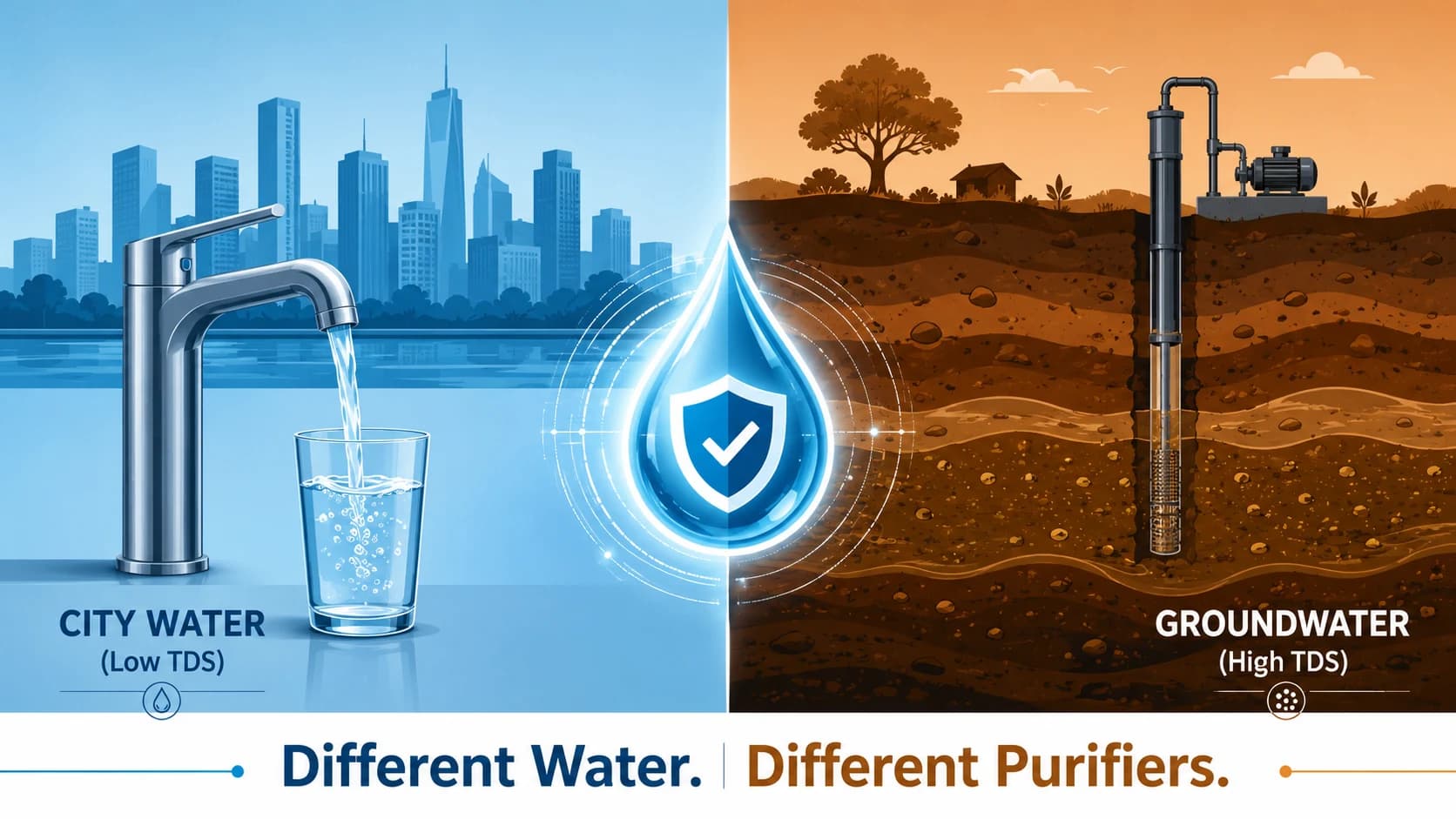
In Punjab, the groundwater contamination situation is well-documented. Research published by the World Bank and India Water Portal identifies uranium, arsenic, nitrates, lead, cadmium, and fluoride at levels exceeding both BIS and WHO limits across multiple districts.
For Amritsar households specifically, the choice is not between "RO water with low minerals" versus "tap water with minerals." The realistic comparison is:
- RO water — low in calcium and magnesium, but free from lead, arsenic, nitrates, and pesticides
- Unfiltered tap or groundwater — contains calcium and magnesium plus documented levels of uranium, arsenic, and agricultural chemicals
In this context, the mineral debate is largely moot. You can supplement calcium and magnesium through diet and a mineraliser. You cannot easily undo long-term exposure to arsenic or uranium.
The National Green Tribunal has flagged Punjab groundwater contamination in multiple orders. This is not a hypothetical risk — it is documented and ongoing.
How to Check If Your RO Output TDS Is in the Safe Range
Testing your water takes less than a minute. You need a pocket TDS meter (available for ₹150–300 on Amazon or any hardware store).
What to do:
- Run your RO tap for 30 seconds
- Dip the TDS meter into a fresh glass of purified water
- Read the number
What the number means:
| RO Output TDS | What It Means | Action Required |
|---|---|---|
| Below 30 ppm | Too low — possible mineral deficiency risk | Add mineraliser or adjust TDS controller |
| 30 – 80 ppm | Acceptable but ideal to be higher | Add mineraliser if possible |
| 80 – 150 ppm | Good range for most households | No action needed |
| 150 – 250 ppm | Ideal for Indian conditions | Perfect — maintain this |
| Above 300 ppm | Membrane may be old or malfunctioning | Service and membrane check needed |
If your output is above 300 ppm, your RO membrane may need replacement. Our technicians carry pocket TDS meters on every service call and test both source and output water as standard procedure.
The Practical Daily Checklist
You do not need to overthink this. Here is the simple daily framework:
- ✅ Use your RO purifier — the contaminant protection far outweighs the mineral concern
- ✅ Confirm your system has a TDS controller or mineraliser and that output TDS is 100–200 ppm
- ✅ Maintain a balanced diet with dairy, pulses, leafy vegetables, and nuts for calcium and magnesium
- ✅ Replace filters and membranes on schedule — a poorly maintained system may fail to remove contaminants
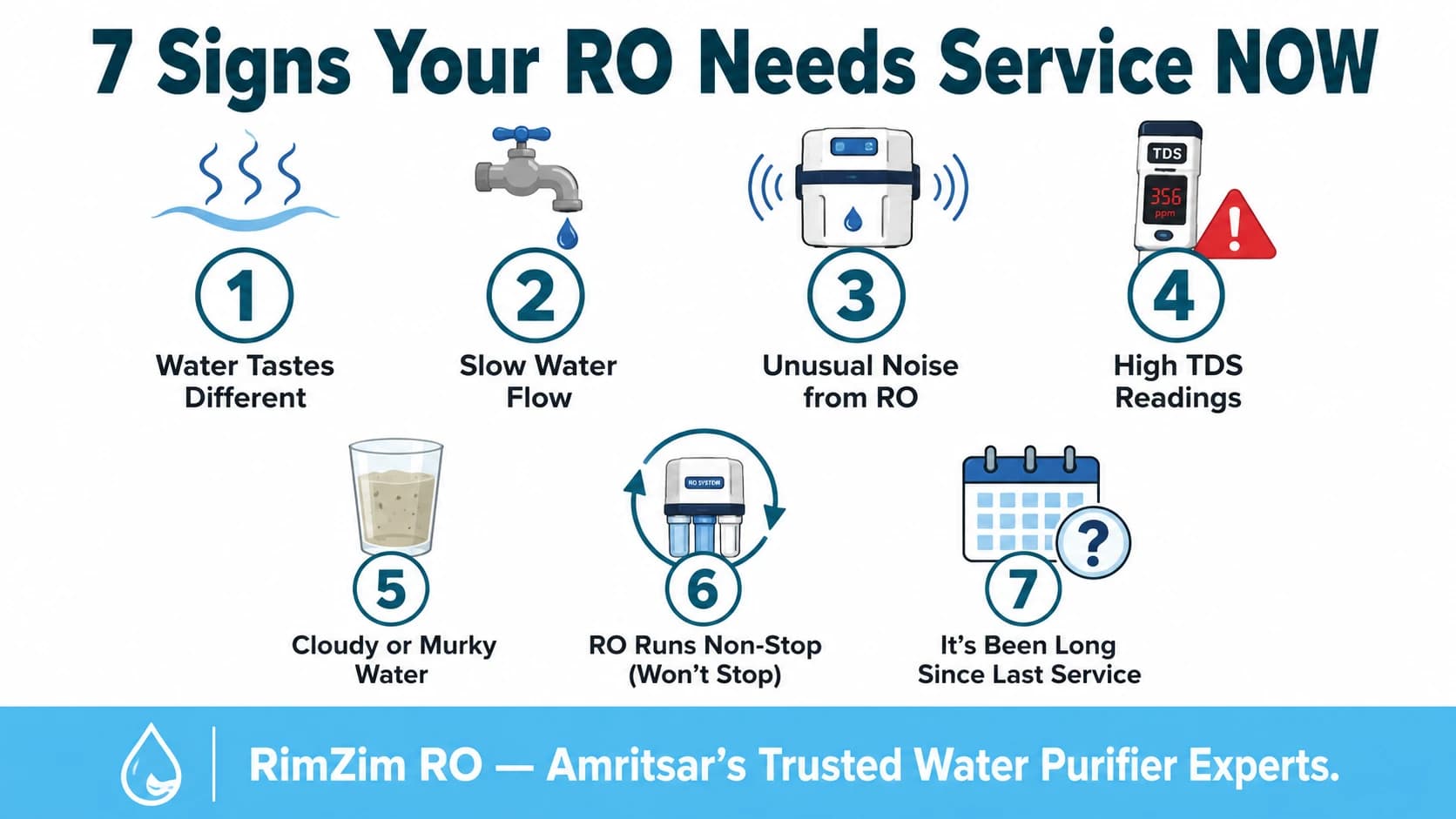
- ✅ Get your output TDS tested at least once a year, or whenever your water tastes different
Our Annual Maintenance Contract includes TDS testing at every visit so you never have to wonder if your system is working correctly.
The Bottom Line
RO water is not inherently unsafe. Poorly maintained RO water — or water from a system without a mineraliser that outputs near-zero TDS — creates a mineral gap that matters more for some households than others.
For the vast majority of Indian families eating a balanced diet and using a properly maintained RO system with a TDS controller, the health risk is low. The protection RO provides against lead, arsenic, nitrates, and biological contamination — especially in Punjab's documented water quality conditions — is far more significant than the mineral debate.
The action items are simple:
- Confirm your output TDS is between 100–200 ppm
- Make sure your system has a mineraliser or TDS controller
- Keep your filters on schedule
- 🔧 Book an RO service and TDS check in Amritsar
- 🛡️ Explore our Annual Maintenance Contract — includes TDS testing every visit
- 🛒 Shop mineraliser cartridges and genuine filters
- 📞 Contact our water quality experts
References
- World Health Organization — Nutrients in Drinking Water (2005 Report) — WHO's definitive assessment of health risks from demineralised water, including calcium and magnesium deficiency implications.
- National Institute of Nutrition, ICMR — Nutrient Requirements for Indians (2020) — India's official dietary reference values for calcium, magnesium, and other essential minerals.
- India Water Portal — Groundwater Quality in India — Comprehensive repository of groundwater quality data, contamination research, and regional water quality assessments across Indian states.
- Central Ground Water Board, Government of India — Official Portal — National authority for groundwater resource assessment, management, and monitoring including Punjab-specific data.
- Jain, C.K. & Singh, S. (2020) — Heavy metal contamination in groundwater of Punjab, India — ResearchGate — Peer-reviewed study documenting arsenic, lead, uranium, and cadmium levels in Punjab groundwater exceeding BIS and WHO limits.
Frequently Asked Questions
Article Insights & FAQs
More Insights
View All Stories
Need Expert Help?
Our certified technicians are ready to service your RO system and ensure pure water for your family.