7 Warning Signs Your RO Purifier Needs Servicing Right Now (Don't Ignore #4)
Is your RO water tasting different? Flowing slower? These are not minor quirks — they are your purifier telling you it is failing. Here are 7 clinically clear warning signs, what each one means, and exactly when to call a technician.
TL;DR:
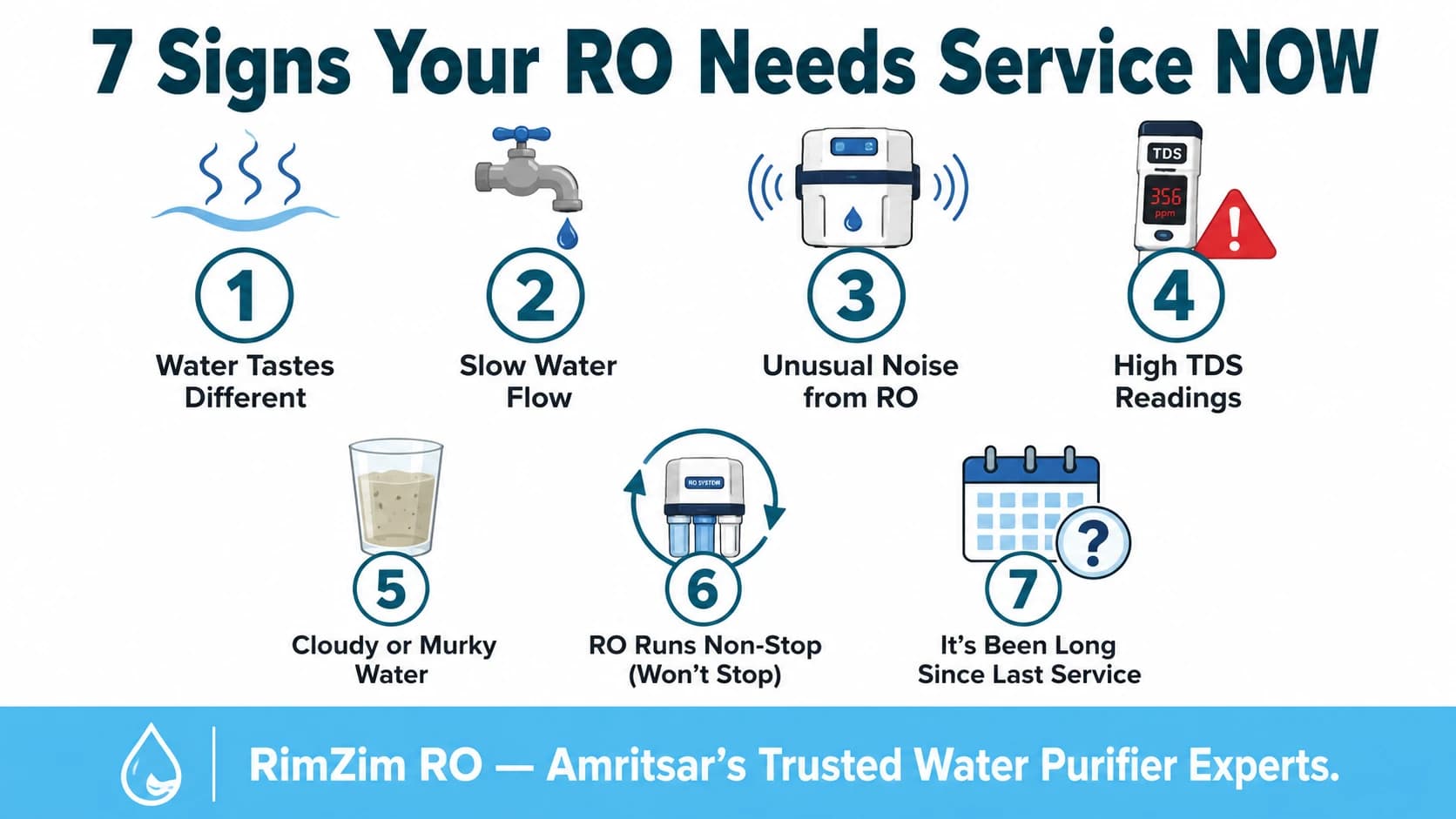
A failing RO purifier does not stop working suddenly — it degrades silently while continuing to run. The seven warning signs are: changed water taste, reduced flow rate, unusual machine noise, rising purified-water TDS, cloudy or particulate water, the machine running continuously without shutting off, and not being able to recall your last service date. Any one of these signals that filters or the membrane need immediate attention. Ignoring them means your family is drinking water that your purifier can no longer actually clean.
What Is an RO Purifier Warning Sign?
An RO purifier warning sign is any change in the machine's output, sound, behaviour, or appearance that indicates one or more filtration stages have degraded beyond their effective working life. These signs appear because RO systems have no single failure point — they deteriorate gradually across multiple stages, and the machine continues running even when it can no longer filter effectively.
Understanding these signals is not optional maintenance literacy — in cities like Amritsar where borewell TDS regularly exceeds 500 ppm, a degraded RO system is worse than no system at all. An expired post-carbon filter can release concentrated bacterial biofilm directly into what you believe is purified drinking water.
Why Ignoring RO Warning Signs Is a Health Risk
Most homeowners assume that as long as the purifier is producing water, it is doing its job. This is the most dangerous misconception in domestic water safety.
Each filtration stage has a finite working life measured in litres processed, not time. Once a stage is exhausted:
- Sediment and pre-carbon filters stop capturing heavy metals, chlorine, and particulates — pushing them directly onto the RO membrane
- The RO membrane begins allowing dissolved salts, arsenic, nitrates, and fluoride through at increasing concentrations as it fouls
- The post-carbon filter — critically — can harbour and release bacterial biofilm if not replaced on schedule, contaminating water after the UV stage has treated it
The World Health Organization's guidelines on drinking-water quality explicitly identify point-of-use purifier maintenance as a critical control point. A purifier serviced irregularly offers no more protection than none at all.
The 7 Warning Signs — Explained Stage by Stage
Warning Sign #1: Your Water Tastes Different
What you notice: A metallic, bitter, sweet, or chemical aftertaste that was not there before.
What it means: Your post-carbon filter is exhausted. The post-carbon (or "polishing") filter removes residual tastes and odours after the RO membrane. Once saturated, it stops absorbing and begins releasing the organic compounds it previously trapped — directly into the water you drink.
A sweet taste specifically often indicates bacterial growth in the storage tank. A chlorine or chemical taste can mean your pre-carbon filter has failed, allowing treated municipal water's chemical additives to pass through unchecked.
Urgency: High. Book a service within the week.
Warning Sign #2: Water Flow Has Slowed Significantly
What you notice: Your purifier takes noticeably longer to fill a glass or bottle than it used to. The tank refills slowly after drawing water.
What it means: Clogged sediment or pre-carbon pre-filters are the most common cause. These filters block particulates from reaching the membrane. As they clog, system pressure drops — the RO membrane receives insufficient pressure to push water through efficiently.
In Amritsar's hard-water zones, sediment filters can clog in as little as 3 months during summer months when water turbidity increases. A slow purifier is not just inconvenient — a low-pressure system forces the membrane to work harder, accelerating its degradation and increasing reject water ratios.
Urgency: Medium-high. Replace pre-filters within the month.
Warning Sign #3: The Machine Is Making Unusual Noises
What you notice: Humming, gurgling, grinding, or high-pitched whining that is new or louder than before.
What it means: Three possible causes, in order of severity:
| Sound | Likely Cause | Action |
|---|---|---|
| Gurgling / bubbling | Air trapped in the system | Flush and re-prime — usually self-resolving |
| Continuous hum | Booster pump overworking due to clogged filters | Replace pre-filters immediately |
| Grinding / clicking | Booster pump motor wear | Requires technician inspection |
| High-pitched whine | Membrane under excessive pressure | Urgent — membrane check needed |
Do not ignore a grinding or high-pitched sound. A failing booster pump running in a degraded state will fail completely — typically at the worst possible time — and is significantly more expensive to replace than a timely service call.
Urgency: Depends on sound type. Grinding or whining = urgent.
Warning Sign #4: ⚠️ Your Purified Water TDS Is Rising
What you notice: You test your purified water output with a pocket TDS meter and the reading has increased — possibly significantly — compared to when the system was new.
What it means: This is the most technically critical warning sign and the one most homeowners miss entirely because it requires a TDS meter to detect.
A healthy RO membrane removes 90–95% of dissolved solids. If your input water is 600 ppm, your purified output should be 30–60 ppm. When the membrane begins to fail:
- Microscopic tears develop in the membrane surface
- Dissolved contaminants — including arsenic, nitrates, lead, and fluoride — pass through in increasing concentrations
- Output TDS climbs gradually: 80 ppm, then 120 ppm, then 200 ppm — while the machine continues running normally
The machine gives no visible indication that the membrane is failing. The water looks and feels identical. Without a TDS meter, this degradation is completely invisible.
Recommended thresholds for Amritsar borewell conditions (500–750 ppm input):
| Purified Output TDS | Assessment |
|---|---|
| Below 50 ppm | Excellent — membrane performing well |
| 50–100 ppm | Good — monitor monthly |
| 100–150 ppm | Borderline — service recommended |
| Above 150 ppm | ⚠️ Membrane failing — book service immediately |
A pocket TDS meter costs ₹200–400 online and takes 30 seconds to use. It is the single most important tool for verifying your RO is actually working. Our RO service team tests input and output TDS at every visit and shows you the before-and-after numbers.
Urgency: Immediate if output TDS exceeds 150 ppm.
Warning Sign #5: Water Looks Cloudy or Has Visible Particles
What you notice: The water coming out of the purifier is not crystal clear — it appears slightly milky, cloudy, or has small floating particles.
What it means: Your sediment filtration has failed. Visible cloudiness in purified water means particulates — sediment, scale, possibly rust from old pipes — are passing through to the output. The sediment pre-filter that should catch these has either clogged and ruptured or degraded past usefulness.
In rare cases, white cloudiness immediately after pouring can be dissolved air (harmless — disappears in seconds). But persistent cloudiness, or cloudiness with floating particles, always requires service.
Do not drink cloudy purified water. Stop using the machine and book a service call.
Urgency: Immediate. Stop use.
Warning Sign #6: The Machine Runs Continuously and Does Not Shut Off
What you notice: The purifier's booster pump keeps running even when the storage tank is full. You can hear or feel the machine running constantly.
What it means: The Auto Shut-Off (ASO) valve — which senses when the tank is at full pressure and closes the inlet — has failed. A stuck-open ASO valve means:
- The machine runs without pause, overworking the booster pump motor
- Reject water flows continuously down the drain, wasting potentially hundreds of litres per day
- The booster pump is likely to burn out from continuous operation within days to weeks
This is a mechanical fault that requires a technician. It cannot be resolved without opening the system and replacing the ASO valve or the associated pressure switch.
Urgency: High. Book within 24–48 hours to avoid pump burnout.
Warning Sign #7: You Cannot Remember Your Last Service Date
What you notice: Nothing obvious. The purifier looks and sounds normal. But when you try to recall when it was last serviced — you cannot.
What it means: This is the most common and most underestimated warning sign. A purifier that seems fine but has not been serviced in over a year is operating beyond the service life of multiple filter stages simultaneously.
Under Amritsar's water conditions — hard, high-TDS borewell or semi-treated municipal supply — this is the realistic filter replacement schedule:
| Component | Replacement Interval (Punjab hard water) |
|---|---|
| Sediment pre-filter | Every 3–4 months |
| Pre-carbon filter | Every 4–6 months |
| RO membrane | Every 12–18 months |
| Post-carbon / polishing filter | Every 10–12 months |
| UV lamp (if present) | Every 12 months |
| Mineraliser cartridge | Every 12 months |
If you cannot confidently confirm when each of these was last replaced, your purifier needs a service audit — not to fix something that is broken, but to verify and reset all the components that are silently expiring.
Our Annual Maintenance Contract removes this guesswork entirely. Every service visit includes component inspection, TDS verification, and a written record of what was replaced and when.
Common Mistakes Homeowners Make
- Waiting for the service indicator light — Many indicator lights are timer-based, not quality-based. They reset when the machine is unplugged and tell you nothing about actual filter condition.
- Judging water quality by taste alone — A failed RO membrane passes arsenic and nitrates with no taste change whatsoever. TDS is the only reliable indicator.
- Delaying service because "it's just filters" — A clogged sediment filter causes membrane damage within weeks. A membrane that costs ₹800 to replace preventively costs ₹2,500–4,000 when the damage is done.
- Skipping service in winter — Filter degradation is continuous regardless of season. Winter is actually when bacterial growth in storage tanks peaks in North India due to reduced tank turnover.
What to Do Right Now
- 🧪 Test your output TDS today — a ₹300 meter tells you immediately if your membrane is failing
- 📅 Check your last service date — if you cannot find the record, treat it as overdue
- 🔧 Book a service visit — our Amritsar team tests TDS on-site, inspects all stages, and gives you a written report
- 🛒 Shop replacement filters — sediment and carbon pre-filters for all major brands
- 📋 Our Annual Maintenance Contract — includes TDS verification and filter health checks at every visit so you never guess again
- 📞 Call us for emergency service — if you noticed Warning Sign #5 (cloudy water) or #6 (continuous running), do not wait
Frequently Asked Questions
Article Insights & FAQs
More Insights
View All Stories
Need Expert Help?
Our certified technicians are ready to service your RO system and ensure pure water for your family.